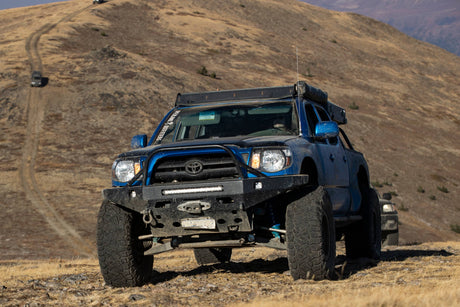

If you wheel a 2nd or 3rd Gen Toyota Tacoma hard, you already know the problem. The truck looks decent until you crawl underneath and stare at that factory transmission crossmember hanging down like an anchor. The frame sits up nice and high, then right in the middle Toyota gave us a big low point that loves to drag on rocks, get smashed, and stop forward progress exactly when you do not want it to.
That is the exact issue the O2 Fabrication Tacoma Flat Belly Kit was designed to solve.
The whole goal is simple: get the belly of the truck up, flatten everything out, protect the drivetrain with stronger steel, and stop getting hung up on the same obstacle every time you hit the trail.
The stock Tacoma crossmember is the problem
On a stock style setup, the underside of a Tacoma is not flat at all. The frame rails sit higher, but the transmission crossmember drops way below them. Then the exhaust often hangs even lower, especially once the skid plates have already taken a beating and started to deform.
That creates two big issues:
- You lose clearance right where the truck needs it most.
- You get hung up constantly when trying to climb ledges or slide across rocks.
On the Tacoma, the measurements told the story immediately:
- Clearance under the crossmember was about 13 3/4 inches.
- The lowest point under the exhaust and skid area was only 12 3/4 inches.
That is not great for a truck that sees real rock crawling.
And it was not just low. It was already hammered. The skid was bent, the crossmember had clearly been smashed multiple times, and there were signs of cracking. That is pretty common once these trucks start getting used the way we like to use them.

What a Tacoma flat belly kit is meant to do
The idea behind a flat belly kit is to get rid of that stamped factory crossmember and replace it with a much stronger, higher tucked structure that supports the transmission while improving the truck’s breakover clearance.
Instead of leaving the exhaust hanging underneath everything, the system also reroutes the exhaust around the back of the transfer case so it can be tucked up higher too.
That gives you a much smoother underside from front to back, which matters a lot when the truck is sliding over rocks instead of trying to plant itself on them.
Our design process started with a precise 3D scan of the 3rd Gen underbody. From there, the brackets and plates are plasma-cut from 3/16-inch plate steel, while the high-stress core of the crossmember utilizes 1/4-inch steel to handle direct impacts.
How the factory setup gets replaced
1. Remove the stock crossmember and old exhaust routing
The first step is exactly what you would expect. The stock low hanging crossmember comes out, and the exhaust that interferes with a high clearance design gets removed as well.
Once that is gone, you have a blank slate to build around.

2. Cut and prep the new plate steel components
The replacement parts were cut from 3/16 inch plate for the kit components, with the finished welded crossmember built from 1/4 inch steel in the critical area. The design includes locating tabs so the parts key together without a lot of guesswork during assembly.
That makes the fabrication cleaner and helps keep everything aligned.

3. Weld in the new high clearance crossmember
Once welded in place, the difference is obvious. Instead of hanging way below the frame, the new crossmember sits just slightly lower than the frame rails, roughly 3/4 of an inch below. It is also notched to maintain proper U-joint clearance.
That means you are raising the belly significantly without creating a new interference point in the driveline.

4. Add the skid system for a true flat belly
With the transmission mount handled, the skid plate can run back in a much flatter line. The front portion comes up and then continues rearward to the new crossmember, creating the flat belly effect through the middle of the truck.
The rear transfer case area is a little trickier, because that section still needs protection while staying strong. The solution here was a rear support bar with frame plates and a skid that includes only a small rise where needed for the transfer case. Aside from that necessary bump, the system stays impressively flat from front to back.
5. Reroute the exhaust for maximum clearance
This part matters more than a lot of people realize. If the exhaust still hangs low, you have just traded one problem for another. So the exhaust is rerouted up and around the back of the transfer case to keep it tucked out of the way.
A flange is also added so that the exhaust section can be removed easily later. That saves you from dealing with hardware farther up the system every time you need access.

The clearance gains are real
After everything was installed, the truck was measured again.
- Under the new crossmember: 15 1/2 inches
- At the lowest point under the transfer case: 15 1/4 inches
That works out to:
- 2 1/2 inches of gain at the lowest point
- 1 3/4 inches of gain through the rest of the belly area
On paper, those numbers are huge. On the trail, they are even more noticeable.

Why this changes rock crawling
Breakover clearance is everything when you are crossing ledges, ridges, and high points between your axles. A low crossmember acts like a hook. It catches the truck, unloads momentum, and turns manageable obstacles into recovery situations.
Flatten the belly and raise that low point, and the truck can glide over terrain that used to stop it cold.
That was exactly the result here.
The truck was taken back to a known obstacle where the old setup used to get stuck all the time. Before the upgrade, the crossmember would catch repeatedly on the same rock marks visible on the trail. With the flat belly kit installed, the truck moved through the section smoothly, barely touching where it used to hang up every single time.
At one spot in particular, there used to be no question about what would happen. The old crossmember would be perched directly on the rock. With the new setup, there was enough room to fit a full hand between the rock and the underside of the truck.
That is not a subtle difference. That is a complete change in how the truck behaves on technical terrain.
Stronger protection matters too
Clearance is only half the story. The other half is durability.
The factory stamped steel setup gets mangled fast if the truck is used in rocky terrain. Once it starts deforming, it hangs even lower and becomes even more likely to catch. In bad cases, it can crack.
The flat belly setup solves that with heavy-duty plate steel and skids designed to take abuse. After months of regular use on the trail, the system showed scratches, which is exactly what you want to see, but it was not folded up and destroyed like the old parts.
That means the skid is doing its job without becoming the next problem.

What it feels like on the trail
The practical difference is huge. Instead of constantly pulling out a winch or recovery boards because the truck is belly hung on the same feature, the truck can now carry itself up and over with far less drama.
More clearance under the middle of the truck means:
- Less dragging on breakovers
- Fewer full stops on ledges
- Less damage to the underbody
- Less reliance on recovery gear for obstacles the truck should be able to clear
- More confidence picking a line through technical sections
For anyone who regularly rock crawls a Tacoma, this kind of upgrade does not just make the truck nicer. It changes what the truck is capable of.

Who this Tacoma flat belly kit is for
If your Tacoma mostly sees pavement, forest roads, or mild trails, you may never push the factory crossmember hard enough to care.
But if you actually crawl rocks and keep finding yourself stuck on the belly, this is the kind of upgrade that makes immediate sense.
It is especially worthwhile if:
- Your stock crossmember is already smashed
- Your skids are bent and dragging lower than they should
- Your exhaust is hanging down and getting hit
- You are constantly getting hung up in the middle of obstacles
- You want stronger underbody protection and better breakover clearance
Installation options
The full kit including transmission crossmember and full skid is available for a full install in our shop or DIY install, depending on how hands on you want to be.
Since the system replaces the factory crossmember and reroutes the exhaust, this is not a tiny bolt-on accessory. It is a real fabrication based upgrade focused on function. But the payoff is the kind of performance improvement you can feel immediately on the trail.

The bottom line
The Tacoma’s factory transmission crossmember is one of the biggest weak points for rock crawling. It hangs too low, gets destroyed too easily, and constantly steals momentum when the terrain gets technical.
A proper flat belly kit fixes that by raising the belly, strengthening the structure, tucking the exhaust, and creating a much smoother underside. In this case, the result was up to 2 1/2 inches more clearance at the lowest point and a truck that can drive over obstacles that used to stop it dead.
If rock crawling is a real part of how you use your Tacoma, this is the kind of upgrade that punches way above its weight. More clearance, less hanging up, stronger skids, and a truck that finally slides over rocks the way it should.