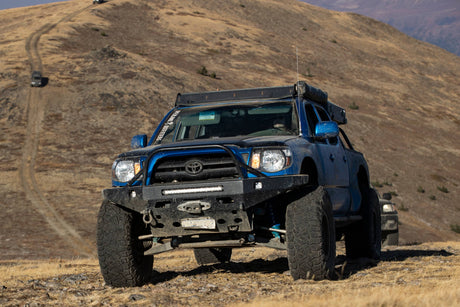

We've all seen the classic scene at the trailhead: a Tacoma or Tundra pulling up the access road, its rear bumper sagging. It's often hauling a vertical hitch rack loaded with five heavy bikes or a truck with six bikes over a tailgate pad, visibly squatting under the weight of gear bags, tools, and a cab packed with riders.
Modern trucks are designed to haul cargo, but the unique stresses of a heavy mountain bike shuttle day create concentrated mechanical pressure on your vehicle. Factory suspension parts are tuned for empty truck beds and smooth highway driving, not for climbing unmaintained forest service roads fully loaded.
If you are running multiple laps on local access roads, here's what your stock truck is dealing with and how you can configure it to manage the load.
The Hitch Rack Leverage Multiplier
When a truck manufacturer sets a maximum tongue weight rating, that figure assumes the weight sits directly on the hitch ball, just a few inches from the rear receiver.
A vertical bike rack changes that setup. A steel or aluminum rack that holds 4 to 6 bikes weighs between 200 and 350 lbs. Since that weight extends several feet behind your rear bumper, it acts like a large lever arm.
This leverage increases the effective tongue weight, compressing the factory leaf springs or coils far beyond their intended height. This sagging at the rear reduces your truck's upward suspension travel, decreases your departure angle, and lifts the front end. This shift unweights your front tires, making steering feel light and unstable just when you need precise control on tight, loose switchbacks.

Tailgate Pads and Concentrated Rear Payload
Loading bikes over a tailgate pad spreads out the weight better than a hitch rack, but it introduces another problem: concentrated payload at the rear.
With five or six bikes over the tailgate, much of that weight is positioned right at the back edge of the bed, well behind the rear axle. Adding heavy gear bags, spare parts, and a cab full of four or five riders pushes your truck near its factory payload limits. Stock leaf packs often do not have the spring rate to maintain a level ride height in these conditions.
High-Frequency Washboard and Shock Fade
Climbing to the trailhead forces your suspension to cycle rapidly thousands of times per mile.
Factory shocks are usually basic low-capacity, twin-tube designs. Under continuous impacts on rough washboard roads, the limited amount of hydraulic oil inside the shock can overheat quickly. This overheating causes the oil to foam and mix with gas. Once the oil foams, the shock cannot control the spring. Your truck starts to bounce uncontrollably, loses tire traction, and can bottom out hard on simple water bars.
The Hidden Threat: Factory Alignment Cam Tabs
Hitting rough roads while heavily loaded puts a lot of lateral stress on your lower control arms.
Independent front suspension (IFS) setups, especially 2nd, 3rd, and 4th Gen Tacomas and 5th Gen 4Runners, rely on thin factory alignment cam tabs to keep the lower control arms in place. Under the stress of a loaded shuttle run, these factory tabs often bend or flatten. Once bent, your truck is out of alignment, knocking your steering wheel off-center and damaging your tires on the way home.
How to Correctly Build a Shuttle Rig
Fixing these problems involves more than just putting in a generic lift kit. Simply raising the ride height without changing the spring rate or shock capacity won't solve the underlying issues. It just makes your truck taller while it still bottoms out. A proper shuttle upgrade needs a reliable combination of three key elements:
- Increased Spring Rate: Upgrade to a progressive add-a-leaf or a heavy-duty replacement leaf pack (like a Deaver Stage 1) to handle the constant leverage from bike racks and bed payloads without sagging.
- Thermal Capacity: Switch to larger-diameter monotube struts or remote-reservoir shocks (like Bilstein 6112/5160 or Locked Offroad 2.0 setups) that hold more oil to dissipate heat and prevent shock fade.
-
Chassis Reinforcement: Install aftermarket Upper Control Arms to restore steering geometry and strengthen your lower frame tabs to avoid alignment problems.
Built by Riders, for Riders
It’s true, we love to build trucks, but we don't just build trucks. Me and a lot of the crew spend our weekends out on the same access roads you do. That’s why pro riders like Jackson Goldstone, Matt Hunter, and Gracey Hemstreet trust our Surrey, BC shop to fine-tune their rigs.
We have made upgrading your suspension easier by offering three specific, trail-tested packages aimed at addressing these common shuttle-day problems.
If you want a dependable weekend setup, need a heavy-duty, fully rebuildable guide rig, or just curious what we can do, then check out our MTB Shuttle Truck Suspension Bundles or reach out to our team to get you sorted.