
If you can only upgrade one thing first, which gives you more off-road capability for the money: locking differentials or more suspension flex?
That question comes up all the time, and it is not just bench racing. Both upgrades help traction. Both can make a truck more capable. But they do it in completely different ways, and the driving experience is not the same at all.
To settle it, we set up a controlled test in the shop using a truck with front and rear lockers and a rear suspension setup that can be switched between near-stock travel and increased articulation. That let us compare lockers against suspension flex without changing everything else at the same time.
The results were pretty revealing.
The test setup
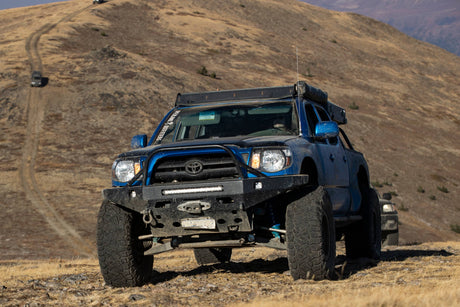
The truck we used already had some solid hardware on it. Up front it was running a mid-travel setup with Bilstein 8112s. Out back it had a JD Fab shock relocation, which gives the rear axle a lot more droop and a lot more articulation than a typical stock-style setup.
To keep the comparison fair, the rear suspension was limited with a strap so it could mimic what a more stock-travel configuration would do with a mid-travel setup bolted on. Then we could remove the strap and let the rear suspension use its full articulation from the shock relocation.
That gave us two suspension states:
- Limited travel, representing a more stock-style rear articulation range
- Full articulation, using the added droop from the shock relocation
Since the truck also had front and rear lockers, we could test four combinations:
- Limited travel, no lockers
- Limited travel, lockers engaged
- Full articulation, no lockers
- Full articulation, lockers engaged
Why articulation matters
The whole point of articulation is simple: keep all four tires on the ground as much as possible.
When the terrain gets twisted, rutted, or uneven, a suspension that can droop farther helps the tires stay planted. More tires on the ground usually means more traction, better balance, and a more stable vehicle.
In this test, the shock relocation gave about 5 inches more droop than the limited setup. That is a big enough difference to change how the truck behaves in a real obstacle.
Why lockers matter
A differential is designed to let the left and right tires spin at different speeds. That is important on the street because when you turn, the outside tire travels farther than the inside tire.
Off-road, that same behavior can work against you. If one tire loses traction or comes off the ground, the differential can send power to the tire that is doing the least useful work.
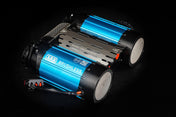
A locker changes that. Once engaged, it forces both tires on that axle to turn together, so even if one tire is unloaded or hanging in the air, the other tire still gets drive power.
That is why lockers can be such a game changer in cross-axle situations.
Why use two ramps instead of one?
We used two ramps because a single-ramp test only tells part of the story. One end of the truck can behave differently from the other, and depending on which way you approach the obstacle, the number changes.
With two ramps twisting the truck at the same time, you get a much better picture of how the whole vehicle responds. It is a more consistent and more realistic way to compare overall capability, stability, and traction.
Test 1: Limited travel and no lockers (Stock-like)
This was the baseline. Four-wheel drive, stock-like rear articulation, no locker assistance.
The result was honestly pretty average, which is exactly what you would expect from a mostly stock-travel truck in a twisting situation.
Measurements landed around:
- Rear ramp height: about 10.5 inches at the main contact point
- Front ramp height: about 11.5 inches
- Rear tire-to-fender gap: about 12 inches
- Front tire-to-fender gap: about 9 inches
The exact numbers are less important than what they establish: this was the control setup, and it did not get very far before traction started becoming a problem.

Test 2: Limited travel with lockers
Then the lockers were engaged while keeping the same limited suspension travel.
This is where things got interesting fast.
The truck could climb significantly farther because the lockers kept power going to both tires on each axle, even as one or more tires started unloading. The rear ramp was basically maxed out as far as the setup allowed, and the truck could keep moving.
But there was a catch: it got tippy in a hurry.
Once the lockers let the truck continue past the point where the suspension alone would have lost traction, wheels started lifting. The truck was no longer composed and planted. It was balancing its way forward.
Measurements were roughly:
- Rear ramp height: about 14 inches
- Front ramp height: about 16 inches
- Front tire-to-fender gap: just over 9 inches
- Rear tire-to-fender gap: about 13 inches
So yes, the lockers absolutely increased capability. They got the truck farther up the obstacle than limited travel alone. But the stability was not great, and the truck felt sketchier doing it.
That matters.

Test 3: Full articulation and no lockers
Next, the limit strap came off so the rear suspension could use its full droop, but the lockers stayed off.
This setup matched the locker-only test surprisingly closely in terms of distance up the ramps. The truck made it to roughly 14 inches in the rear and around 16 inches in the front, which was basically the same stopping point as the stock-travel setup with lockers.
But the way it got there was completely different.
Instead of lifting tires and feeling unstable, the truck stayed planted. It felt balanced. Controlled. Solid.
The rear tire-to-fender gap jumped to around 16.5 inches, which showed just how much more droop the rear suspension had available compared to the limited setup.
In other words, suspension flex alone got to about the same place as lockers alone, but with much better stability.
That is a huge takeaway.

Why the test stopped when it did
The truck likely could have gone a bit farther, but the ramps themselves started becoming the limiting factor.
As the rear axle articulates, it does not just move straight up and down. It also wants to rotate slightly, which creates a little bit of rear steer. That means one rear tire can start pointing inward just enough to push awkwardly against the ramp and make the setup unstable.
So while the suspension had nearly reached its maximum useful travel anyway, the ramps were beginning to get a little too sketchy to keep pushing.
Test 4: Full articulation with lockers
This was the all-in setup: maximum rear flex and lockers engaged.
As expected, this was the best performer by a comfortable margin.
The truck climbed nearly to the top of the ramps and, more importantly, did it with a lot more composure. It felt far more controlled because the articulation kept the truck planted while the lockers prevented wheel slip.
That combination gave the best of both worlds:
- More tire contact from the added suspension droop
- More predictable drive power from the lockers
- Better stability than lockers alone
- Better traction than flex alone
The final measurements were about:
- Rear ramp height: around 15.5 inches
- Front ramp height: a little over 16.5 inches
- Rear tire-to-fender gap: about 17 inches
- Front tire-to-fender gap: about 9 inches
That setup felt planted and in control right up near the top of the obstacle.

What the test really showed
The obvious answer is that having both lockers and good suspension is best. No surprise there.
The more useful question is what happens when you can only afford one upgrade first.
Here is the clearest way to frame it:
Lockers give you capability
With limited suspension travel, lockers let the truck continue forward even after tires start unloading. That means they can absolutely get you through situations where an open differential truck would stop.
They are especially useful when you are stuck, crossed up, or trying to power through a short obstacle that steals traction.
But they can also push you into a position where the truck is less stable. You may keep moving, but you may not like how it feels.
Suspension flex gives you stability
More articulation helps the truck stay composed. It keeps tires on the ground longer, improves balance, and makes technical terrain feel less chaotic.
In this test, full articulation without lockers performed about as well as limited articulation with lockers, but with much better control.
That is not a small difference. Control matters just as much as raw forward motion when the terrain gets more interesting.
Together, they transform the truck
When you combine lockers with suspension flex, the truck becomes much easier to place, much more predictable, and much more capable. There is less wheelspin, less drama, and less of that sketchy balancing act that happens when lockers alone are trying to compensate for poor tire contact.

So which should you choose first?
This is where it gets tricky, because the right answer depends on how you use the truck.
If the goal is straight-up off-road capability, lockers probably win the first-upgrade battle.
Why? Because when you are actually stuck or losing traction, lockers are more likely to get you moving again. They help in those quick, ugly situations where one tire unloads and all your momentum disappears. In practical terms, that can save you more often than suspension alone.
That said, lockers do have limits. If the obstacle gets too extreme and the truck starts getting dangerously off-balance, they cannot fix the fact that the vehicle is becoming unstable. There is a point where flex matters more because it keeps the truck from tipping into a bad situation in the first place.
On the other hand, if you care a lot about ride quality, composure, and suspension performance in general, added articulation has benefits beyond the ramp test. A better rear suspension setup improves how the truck behaves all the time, not just when one tire is dangling in the air.
So the real answer looks like this:
- Choose lockers first if you want the biggest jump in pure traction and obstacle-clearing ability.
- Choose suspension first if you value stability, planted handling, and better overall suspension performance.
- Choose both if you want the truck to feel truly dialed in off-road.
The bottom line
After running all four combinations, the takeaway is pretty straightforward.
Lockers are probably the better first upgrade for outright capability. They are more likely to get you through or out of a tough spot when traction disappears.
Suspension flex is the better upgrade for control and stability. It keeps the truck planted and confident in twisted terrain, and in this test it matched lockers-only performance without the same tippy feeling.
The best setup is both. That is where the truck becomes easy to manage, predictable, and seriously capable.
If you are deciding between locking differentials and a suspension upgrade like a shock relocation, think about what you need most right now: getting unstuck more often, or staying more composed while you tackle obstacles. That answer will usually tell you which direction to go first.
And if you’re looking for some quality entertainment and have an extra 20 minutes to spend watching a video, you can check out the first time we tried this test in an extremely uncontrolled environment:
Until next time.